

Card #1

Alright, we're going back to the vintage-ish stuff for this first card folks.
That's a beautiful full bleed shot featuring former Chunichi Dragon, Takamasa Suzuki.
Suzuki spent his entire 17 year career with the Dragons as a reliever/closer. Early on he was a pretty good closer who led the league in saves a few times, but later on he was entrusted more in middle relief. His roles varied, sometimes he was a long reliever in mop-up duty, other times he was the fireman there to snuff out any rally the opposing team had brewing.

The back of the card states that he's in his sixth year as a pro, meaning this card is from 1978. The blurb mentions that he's a fierce competitor and that even when opponents do damage against him he takes it all in stride.
Anyway Suzuki retired following the 1989 season and spent some time as a baseball analyst/announcer on the radio before taking up coaching. He hasn't coached since 2013 and since 2014 he's gone back to radio but still pops up every now and then at baseball events relating to retirees and the Dragons.
Card #2

Hey, our first Owners League card in this post! We're covering all the bases here!
Anyway this is a cool card of Yomiuri Giants great, Tetsuharu Kawakami. His nickname was 打撃の神様, which basically translates to "The God of Hitting". So yeah, everybody arguing whether Babe Ruth or Ted Williams is the greatest hitter of all time has been wrong forever, that honor goes to Kawakami. Although to be fair during his playing days he was known more as "Red Bat" because he swung with a literal red bat.
Actually much like Ruth, Kawakami was originally a pitcher. During his days as an amateur/scholar he was known for being an impressive southpaw. Eventually he tried doing both pitching and hitting but ultimately ended up converting to first base full time following an injury to the Giants' 1B at the time. From 1939 to 1942 he dominated the competition, leading the league in hits, doubles, triples, total bases, home runs, RBI, batting average, OPS and OBP at various times during that span. Keep in mind that he was still a pitcher during that time so he was basically putting up Mike Trout levels of production while pulling a Shohei Ohtani.
After 1942 he went to fight in the Pacific War and following the end of that war he went home to take care of his family by taking up a life as a farmer. But of course the story doesn't end there, as the Giants found themselves in a playoff race and wanted their star hitter back. Kawakami asked for 30,000 yen, which adjusted for inflation and converted into USD would be more than $10,900 USD. That doesn't seem like much now but back then? In post-WWII Japan? That's some serious coin right there. Of course the Giants wanted to win so they paid the player what he wanted.

Kawakami returned to pro baseball and went on to establish records, such as being the first to have 1,500 career hits and later 2,000 career hits. Once the Nippon Series became a thing in 1950, Kawakami, the man who once famously said that he sometimes saw pitches that looked like they stopped right in front of him, and his Giants won the first three Championship titles in 1951, 1952 and 1953. Get this, in 1951 he only struck out SIX times in 424 at-bats. He and the Giants won the title again in 1955, 1956, 1957 and 1958.
Unfortunately by 1958 Kawakami's best years were long behind him and he decided to retire. The future was (and would still continue to be) bright for the Giants though because in 1958 they had a young 22 year old rookie named Shigeo Nagashima. And a year later they'd get a 19 year old rookie named Sadaharu Oh. Both Nagashima and Oh would go on to be NPB legends and carry on the new Giants dynasty for the entire 60's and 70's. Kawakami stuck around during most of that new dynasty as a coach/manager BTW.
I found researching Kawakami to be quite fun. Even after his active playing days ended he stuck around as a manager/coach for a few years before leaving that part of baseball in the mid 70's. After that he did some work as an analyst and baseball writer, but apparently spent a lot of his free time golfing (what is it with baseball players and golf?). He lived a pretty long life, living to the age of 93 and passed away in 2013. Leaving behind a Hall of Fame career that got overshadowed by the same players he passed the baton to.
Card #3
Alright so how do I finish off this post that's largely been about a Dragons legend and The God of Hitting? Simple, by talking about my favorite Dragons legend who is considered a God in his own right.
Notice how earlier I said the Kawakami-led Giants won the Nippon Series for the entire 50's minus 1954 (they lost in '59 too BTW). Want to take a guess as to who did win the Nippon Series in 1954?

Hell yeah, my favorite NPB legend of all time Shigeru Sugishita and the 1954 Chunichi Dragons won it all that year!
Who else but the God of Forkballs could contain the God of Hitting for one year?
Sidenote, I would kill to see a matchup between the two Gods.
But yeah, this was the only hit-oriented Sugishita pickup I made. I love this autograph and made a mental note to acquire it before I went to Japan because I just love the design. It's got this cool woodgrain look (although it doesn't feel like it), and the part where the signature is supposed go is brighter but not in a distracting or forceful way like it is with most autographs. Here it's a lot more natural. The fact that the autograph is on-card makes it that much better. Sidenote, the fact that EPOCH uses on-card autographs is said to be their "appeal". Because BBM's autographs are pretty much always stickers. This is where EPOCH swooped in. Because of this BBM's said to start testing out on-card autographs too (although not really if their offerings being same is any indication). So if you were curious about what the point of EPOCH existing and printing cards was, there you go. It's to provide on-card autographs to the market.

Yes it's numbered. Yes it cost me north of $50 USD. But you know what? It's a HoF/God autograph. It's worth every last yen.
 |
| Copyright Sports Graphic Number/Bungeishunju |
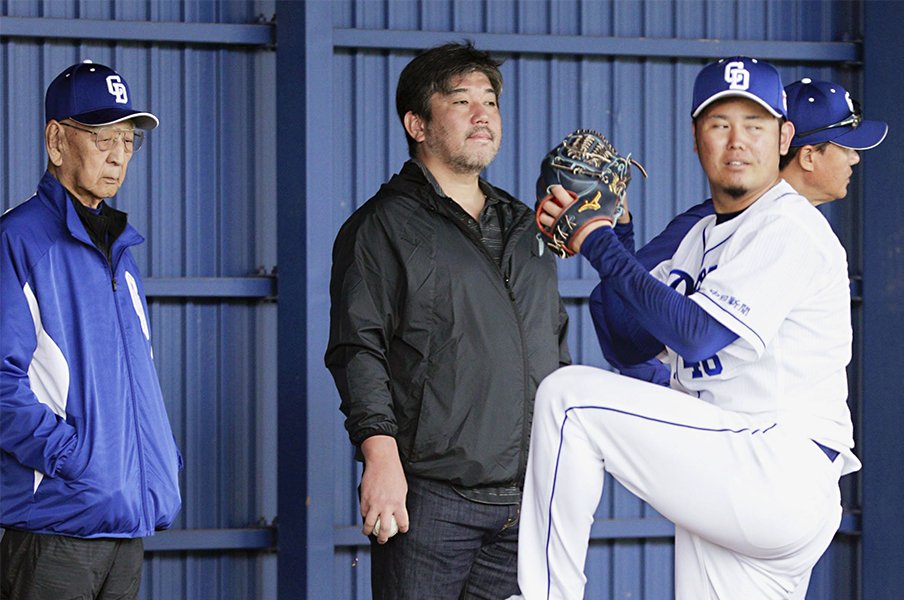
BTW, Sugishita recently made a public appearance again by showing up to the Dragons' Spring Training Camp in Okinawa. The God of Forkballs was also accompanied by former MLBer Hideo Nomo. Sugishita showed up wearing a wind-breaker and to give advice to a young core of pitchers that really need all the help they can get. Also, Nomo gained a few (read: lot of) pounds since retiring.
And that was a legend-stuffed edition of 3 cards. As always thanks for stopping by and take care :).

0 Yorumlar