

 |
No, my parents weren't Bolsheviks or Trotskyites who weaned a "red diaper" baby, they were thoughtful Americans who, after a World War Two marriage, and four kids in almost as many years, simply tried to keep a few American ideals and a sense of humor alive in our household. Consequently, when they discovered us huddled in front of a flickering t.v. image seemingly enthralled with Frank Lovejoy confessing that I Was a Communist For the F.B.I. (1952) or bringing home a now forgotten artifact from our parochial school such as Treasure Chest comic books, (which were chock full of depictions of life under the boot of "godless Communism"), they leavened the heavier fear mongering with large doses of faith in American ideals such as freedom of speech and encouraged us to explore the free marketplace of ideas, where we might hear all sides of every issue.
Still, if you ever took part in a nuclear fallout drill at school, there's probably at least a shadow on your soul and maybe a bit of skepticism in your outlook on life. Oh, yes, and a certain fascination with an odd group of films that laid claim to at least part of your imagination. When a certain Congressman Nixon exhorted a non-plussed Jack Warner and Louis B. Mayer that Hollywood had "a positive duty" to make anti-Communist movies, most moguls, including the fairly liberal minded Darryl F. Zanuck at 20th Century Fox, took this exhortation to heart.
 |
| William Wellman |
Despite or because of this "larger than life" quality, this and the other films of this period still loomed large in my consciousness as a kid and teenager. The sheer hyperbole of these movies, which, given the revelations of the KGB files that have come to light since the fall of the U.S.S.R., wasn't all that exaggerated, made them a bit hard to swallow, if strangely entertaining. Maybe as a result of all this, movies about commies continue to fascinate me, even while offering an interesting glimpse at an earlier "long twilight struggle" in our country's history.
William Wellman, who would probably be the first guy to say that he was "just" a contract director, capable of molding almost any script into an acceptable product, may have looked like a good choice for churning out what is often cited as the very first of a plethora of Cold War movies. Making what appears to be an apparent propaganda picture just a year after the 1947 HUAC hearings that began the blacklist period against those in the entertainment field, Wellman chose a typically circuitous route rather than an obvious road to the right. Unlike many of the later films in this cycle, such as those already mentioned and ones like The Red Menace (1949), which are laughably bad, Wellman tried to keep it real. Reportedly one contract director of a particularly slapdash pot-boiler said that he was assigned to such a picture simply because he was told that "This McCarthy thing seems to be catching on and we need a film quick!"
 |
| A Belgian poster for The Iron Curtain (1948) |
Yet just when I think I have the films of William Wellman neatly tucked away in a mental safe deposit box, marked "W" for "Wild Bill", the guy throws me a curve. As demonstrated in a recent TCM tribute to William Wellman, the range of this sometimes overlooked director, and the sheer variety of his films over the decades makes any tidy pigeon-holing of his style nearly impossible. Adventure, war, comedy, and even a musical or two dominated his career.
Visually, his films are full of movement and Wellman seems to enjoy taking us on one hell of a ride. Over time, he took his audience from that seat in the cockpit of a fragile World War One biplane in Wings (1927) to that liberating flight of an anonymous farm woman's life from oppression in So Big (1932), to the upheaval of a teenager's nightmarish journey on the rails in Wild Boys of the Road (1933) to that most incisive examination of the consequences of a mindless rush to judgment in the brilliant The Ox-Bow Incident (1943).
Still, one of the aspects of his movies that I find most engaging is his ability to remind me that large current events have an impact on individual, highly fallible human beings. This side of Wellman's range was illustrated by such brutally realistic movies as the Pre-Code story of a drug addicted veteran (Richard Barthelmess) in Heroes for Sale (1933) and the strange, often amusing yet squirrelly metaphysical mixture of the compelling and the trite in a unique film, The Next Voice You Hear (1950), which attempts to show how "Joe Smith, American" (James Whitmore) reacts to a direct word from God in the midst of his not so quietly desperate life.
One seemingly forgotten Wellman movie, The Iron Curtain(1948), which is not on vhs or dvd, and was not part of the TCM retrospective, is one of those films that takes a break from all this breathless commotion. An odd movie, even for one of the first in that dour, hysterical sub-genre, the Cold War picture, it gains a kind of rough hewn poetic power by stopping to examine the bleak prospects for one man in a gray post-war world. If you expect a rousing adventure tale from Wellman, think again. What made this film quite moving was the director's refusal to exaggerate the inherent dramatic qualities in the story and kept it on a human scale, not a geopolitical one. He chose to mute the details of what hyperventilating posters screamed was "the most amazing plot in 3300 years of recorded espionage!!"
The Iron Curtain is based on the actual 1945 case of Soviet cipher clerk Igor Gouzenko, (Dana Andrews with a brutally short, just-back-from-the-Eastern-Front haircut), who, after careful training, was assigned to the U.S.S.R. Embassy in Ottawa, Canada in the midst of World War II. Eventually, Gouzenko defected with 109 pages of material implicating several high level Canadian officials, outlined the steps taken to secure information about the the details of the nuclear bomb via numerous sleeper cells established throughout North America. The scandal that resulted when details of this case were publicized by American columnist Drew Pearson in early 1946 involved Canada, Britain and the United States. As dramatized by Wellman in this movie, it becomes more than a tense story of international intrigue, but a depiction of a man who may have lost his moorings as well.
 |
| Gene Tierney and Dana Andrews as a Soviet couple under constant scrutiny in Canada. |
 |
| Eduard Franz |
Casting the leading character with Dana Andrews as Gouzenko was also fortuitous. Initially, he appears to be a finely tuned apparatchik who takes a certain savvy pride in doing his job of deciphering and formulating coded messages in the Ottawa embassy.
Arriving at the Canadian embassy in 1943, (when America & the Soviets were united against the Nazis), Andrews is accompanied by the doctrinaire Colonel Trigorin (Frederic Tozere), a true believer in the Soviet way of life, and a cynical, dissolute son of a Soviet hero, Major Kulin (Eduard Franz), who creates an impressive if somewhat unwieldy portrait of a flashy character in only his second film role. Franz is a drunkard and a haunted witness to the ruthless sacrifices of the Soviet people made during the war. His ramblings are indulged because of his connections, but he also is the only character who tells the truth loudly and all the time. As such, Eduard Franz has to voice the film's indictment of Stalin's totalitarianism and the repression of Soviet society, but this is surprisingly free of what would seem to be McCarthy-style cant. Because Franz and other characters are presented as human beings, not caricatures spouting simple slogans, the viewer is allowed to recognize their flaws and virtues as similar to our own. By contrast, Andrews' character initially appears to be a most efficient bureaucrat.
Arriving at the Canadian embassy in 1943, (when America & the Soviets were united against the Nazis), Andrews is accompanied by the doctrinaire Colonel Trigorin (Frederic Tozere), a true believer in the Soviet way of life, and a cynical, dissolute son of a Soviet hero, Major Kulin (Eduard Franz), who creates an impressive if somewhat unwieldy portrait of a flashy character in only his second film role. Franz is a drunkard and a haunted witness to the ruthless sacrifices of the Soviet people made during the war. His ramblings are indulged because of his connections, but he also is the only character who tells the truth loudly and all the time. As such, Eduard Franz has to voice the film's indictment of Stalin's totalitarianism and the repression of Soviet society, but this is surprisingly free of what would seem to be McCarthy-style cant. Because Franz and other characters are presented as human beings, not caricatures spouting simple slogans, the viewer is allowed to recognize their flaws and virtues as similar to our own. By contrast, Andrews' character initially appears to be a most efficient bureaucrat.
 |
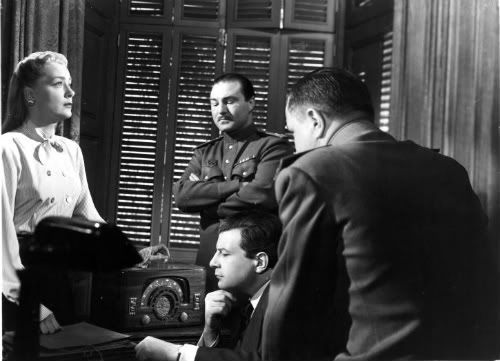
| Gouzenko's colleagues at the embassy, including June Havoc and Stefan Schnabel (seated) listen warily to the news and interpret it through their world view, guarding their private views from one another. |
 |
| June Havoc |
We learn that one reason for Dana Andrews sales resistance to Havoc's pitch is that he loves his wife, played by his frequent screen partner and fellow Fox contract player, Gene Tierney. She soon arrives from Moscow, and Tierney, who sometimes seemed overwhelmed by some of her more complex characters, is given a warmhearted, relatively straightforward role to play. Despite his joy in creating a small home in a decent apartment away from the tense embassy in Ottawa with Tierney, Andrews warns her repeatedly against forming any attachments to "others", i.e. ordinary Canadians. This is particularly true of a neighbor, played with just the right note of easily misinterpreted bustling concern for the couple by Edna Best. As Dana explains to his increasingly westernized spouse, "We're simple people, Anna, we can't understand everything, we must have faith in our leaders."
 |
| Gene Tierney, Edna Best (as their neighbor) and Dana Andrews in The Iron Curtain (1948) |
 |
| Berry Kroeger |
This realization is most dramatically evident in the scene when Dana Andrews and his co-workers discuss the power and horror evidenced by the first atom bomb dropped by the U.S. at Hiroshima. Andrews' superior is riveted by the thought of acquiring such knowledge and power. As a new father and a man whose ties to life have been reawakened, Gouzenko is deeply disturbed. Gradually, he comes to the realization that he and his family will not return to Russia, in part because he does not want his newborn son to grow up to fight in another war, especially one that might possibly fought with nuclear weapons.
The atmosphere at this point of the movie becomes increasingly dark, literally and figuratively as the film conveys a sense of the dim winter light of a Canadian winter and the weight that Andrews and Tierney carries within them as tensions build. Charles G. Clarke, a cinematographer whose brilliant use of Technicolor in films such as Captain From Castile (1947) and Violent Saturday (1955) is probably better remembered than his black and white films. Wellman, whose distinctive claustrophobic style in black and white westerns such as The Ox-Bow Incident very likely shaped the look of this film as well.
When Andrews learns that he will shortly be sent back to Russia, he decides to take an irrevocable step. He steals important documents tracing the ties of his countrymen to the ring of American and Canadian citizens who have provided the Soviets with secrets related to nuclear weaponry. As he becomes more committed to defecting, (despite what will happen to his unseen family back home in the Soviet Union), he develops a rather half-baked idea that handing this vital proof over to the Canadian Justice Department will be easy and earn him a welcome from the Canadians. It becomes a race against time to get the documents into the right hands as well as save his family, even if he can't save himself. The anxiety and tension that is created by the director as we see the rather naïve Gouzenko traipse from bureaucrat to bureaucrat in Ottawa, trying to convince someone, anyone, of his sincerity and the gravity of the information that he has to give them. With his wife and baby bringing up the rear in much of this segment, there's something Kafkaesque about Andrews hapless trek around the dingy, snowy streets of Ottawa, (which can't have looked all that different from Moscow at times).
Eventually exhausted, gazing stonily ahead as only Dana "Master-of-the-Thousand-Yard-Stare" Andrews can, afraid to go back to his apartment for fear of interception and knowing that his disappearance has been noted by his colleagues by now, he practically stumbles into the bustling office of The Ottawa Journal newspaper. Just as the viewer assumes that freedom of the press might win the day, (à la the seventies' Three Days of the Condor), Andrews is given the proverbial bum's rush by a harried, disinterested night editor. Returning to the family flat, he secretes his wife and baby with the neighbor, and waits alone in the dark for the inevitable knock on the door.
The way that sound is used by the director throughout the movie, with the painfully loud Russian music used to indicate the relentless nature of the state's control over its subjects at the embassy, and, in this scene in particular, the ominous quality of the somewhat startling knock.
Here the director also lets the actor's ability to register several subtle transient emotions at once on his face express what the perfunctory script does not. As the inevitable strong arm men arrive, when they pound at the door, Andrews shows frozen fear, relief and determination to stand up to them as best he can, until the intervention of one of the R.C.M.P. who, in the uncredited appearance by that all round utility man in forties movies, John Ridgely, arrives in the nick of time to administer some simple justice despite the claims of diplomatic immunity by the embassy goons, confiscating the papers that Gouzenko had risked his life for "until things can be cleared up down at the station." To this end, Wellman has restrained the drama of the story, making it a singularly effective movie to this day through its straightforward narrative, enhanced by another overlooked performance by the perfect actor for the Age of Anxiety, Dana Andrews.
 |
| The film's sunny conclusion in The Iron Curtain (1948) |
Long story short, once someone sensibly realizes that Gouzenko's evidence proves that Stalin was actively trying to steal nuclear secrets and that previously unpublicized concepts such as "sleeper cells" becomes known, this event helped trigger the Cold War. In reality, these events led to the indictment of a total of 39 suspects, of which 18 were eventually convicted, including the only Communist Member of the Canadian House of Commons and the national organizer of the CP in Canada. The far-reaching leads given the authorities stemming from this case have also been tied to Julius and Ethel Rosenberg case in the U.S. and the Cambridge Five (Kim Philby, Guy Burgess, Anthony Blunt, Donald Maclean and John Cairncross), in the U.K.
 |
| The author appeared in public for a time with a hood over his features. |
But 20th Century-Fox intends to open it simultaneously in 500 U.S. theaters. The film tells much less—in quantity—about Communist spy activities than the daily press has already told. Yet the alarm and breast-beating of the opposition are an understandable tribute to the enormous and unique power of motion picture propaganda in general, and of this film in particular." We are still living with the aftermath of this relatively small opening salvo of the Cold War, but, the real Igor Gouzenko, and his wife, Svetlana, (called Anna in the movie), were depicted at the end of the film as living in secrecy in a rural region of Canada under RCMP protection. In another in a sense, Gouzenko a restless man without a country from then on. Living under assumed identities created by the R.C.M.P, the Gouzenkos raised eight children together, (I guess there had a lot of time on their hands in protective custody).
Gouzenko, with a flair for the dramatic, managed to keep in the public eye, writing the book that was the basis of this movie, This Was My Choice, and a novel The Fall of a Titan, which met with some success in the fifties. Igor Gouzenko also appeared on Canadian television from time to time, largely to promote his books, but also to air his periodic grievances with the RCMP, which he often complained was not compensating him sufficiently, though his family was supported by the RCMP at least until his death in 1982. Whether needed or not, whenever Gouzenko appeared in public, he always wore a hood over his head.
 |
| The real Igor Gouzenko in the '50s. |
A movie history addendum: One scholarly examination of the McCarthy era noted that as Hollywood's explicitly anti-Communist films rose from three in 1948 to thirteen in 1952, Communists "were characterized in the gangster tradition as tough men who rule with an iron hand and use violence as their primary weapon. They were, in effect, B pictures, the successors to Bulldog Drummond and Boston Blackie"..."though conservatives in both Hollywood and Washington believed that a vast public hungered to see anti-Communist movies, none of them made any money"..."perhaps [proving that] the conventional wisdom was right, that nobody wanted message pictures anyway."
Black, J. L. & Rudner, Martin, eds., The Gouzenko Affair, The real Igor Gouzenko
Penumbra Press, 2006.
Canadian Broadcasting Archives, The Gouzenko Affair,
Friedrich, Otto, City of Nets, Harper & Row, 1987.
Landon, Philip J., The Films of the Cold War, http://userpages.umbc.edu/~landon
Time Magazine, The New Pictures, May 17, 1948.
Online Resource:
Igor Gouzenko - Cold War
(Originally published by me at MovieMorlocks.com, Jan.23, 2008. Reprinted here with the kind permission of Turner Classic Movies.)







0 Yorumlar